Showing posts with label editorial. Show all posts

Friday, August 28, 2015

20 Years Later, Chrono Trigger Amazes Me


For as many games as I've played, I have a few glaring holes in my game history. I've only played two Megaman games, I didn't play Metal Gear Solid until I was 18, and one of the biggest gaps for me is how little I've played Chrono Trigger.

After I experienced Final Fantasy 7 when I was seven, the series quickly became my absolute favorite. The games of Squaresoft and eventually Square Enix at large also made their way to me, and I found a love of JRPGs. It's strange then that Chrono Trigger conspicuously went under my radar, especially considering that it's sequel Chrono Cross was a game that I played when it released. Either way though, I didn't end up playing Trigger until its release on the Nintendo DS in 2008.

At this point, I didn't find myself drawn in by the experience. I was in a mindset that it had to be like Final Fantasy for me to enjoy it, and Chrono Trigger was just different enough to put me off of it a bit. Another compounding factor in this was Chrono himself as the silent protagonist. I thought I wanted more "character", and this was before I realized how strong of characterization a silent protagonist can actually have.

Long story short I never finished the game, even though I played over 50% of it. This isn't to say I hated Chrono Trigger or anything, it just didn't keep me involved. After last weeks episode of Playing with Perspective where we talked about Chrono Trigger, I found myself inspired to pick the game up again to try and complete it. This time around I'm finding myself enjoying it much more, for a multitude of reasons. As I've matured, I've come to appreciate games much more instead of being in that mindset where they have to be one way or another.


One part of Chrono Trigger has really stood out to me so far though. A part I had completely forgotten about somehow, but one that is a fascinating commentary on player choice and consequence. Chrono Trigger opens with you attending the Millennial Fair, happening to run into a young girl named Marle. You're able to spend time at the fair and do some odd activities like racing, fighting a giant robot, collecting points, and finding random items. As the story progresses Chrono finds himself on trial for kidnapping Marle who turns out to be the princess.

Here Chrono is put on the spot and forced to defend himself as citizens from the fair get called in to testify against Chronos "character."This includes people testifying on things Chrono has done, that can be different depending on what you did during the Millennial Fair. In my play through, I found a sandwich sitting on a shop that of course I ate. I also talked to a little girl who was looking for her cat, but was too busy playing games and getting on with the story to bother with it. It's still an amazing turn when the game throws these things back in your face. It completely destroys the status quo that we've come to expect with typically JRPGs.


This is when something amazing happens with the game, because it belays your expectations here you come to think more seriously about choices and your actions in the rest of the game. Here is when Chrono as a silent protagonist really becomes you. As a player you see your choices directly effecting a character in the game, and now suddenly it feels like your more of a part of this world.

Chrono Trigger made an absolutely brilliant decision when it put this reactive scene in. Although the outcome of the trial is the same no matter what, by putting this design choice in the game, it gets the player that much more involved in its story and events. Anytime a game can do this in an effective way, you really see the pay off. We should use this instance in Chrono Trigger as an example of reactive design. This is something that a lot of Telltale games do well too.

I'm hoping that I can make the push to finally finish Chrono Trigger this time, and I feel confident that I can. I find myself much more involved with the story and characters this time. The trial scene was one of those instances that just lept out at me, as a wonderful design choice. Chrono Trigger is certainly a wonderful gem that I wish I hadn't missed.

Friday, August 14, 2015

Experiencing Video Game Fatigue


Sometimes there is some truth to having too much of a good thing. This applies to anything that you like or enjoy, and sometimes because of life events you just experience burnout.This has happened to me personally at various points in my life, and it happened again recently.

As much passion as we hold for video games, and as much enjoyment as we get out of playing games, sometimes it' just too much. Video game fatigue can hold especially true in today's ecosystem, because of the hugely flooded market we have. There's so many games to choose from, that sometimes it can just become overwhelming as you look at your 'pile of shame' twenty games high.

For as much effort I put into this career of becoming a video game journalist, I don't get all that much to to actually play games. With school, a full-time job, a second part-time job, research for a radio show, and my own personal research my life is a blur of business. Not to mention the struggle I have to keep any kind of healthy social life. With this fact in mind, I found solace in The Witcher 3. As a lot of people who might associate with me know, I sunk myself into the game and found utter joy in analyzing it as much as I could. However, some time after beating it I found out the mistake I made.


Sinking yourself wholesale into a game can be a dangerous proposition, you spend countless hours pouring over the games systems, lore, story and whatever else you might be invested in. In my example, I had so utterly sunk myself into The Witcher investing over 150 hours, playing it on every spare chance I had. Upon completion of the game, I felt lost. For almost two months I had played The Witcher, it was my go-to game whenever I had that rare chance of down-time.

Of course there is a caveat to this fact in the truth that the whole time I was playing the Witcher I was escaping from issues in my life. A myriad of issues had assaulted me this summer, from sick and dying family members to confidence and identity issues. The Witcher 3 was the game I needed at this point, a grand fantasy adventure that I could really get invested in, but it also led to my most recent bout of burnout.

Video games as a medium are different than other forms of entertainment. It takes a commitment on the players part, and in one way or another each of us has to take the time to put ourselves in the game and push through the narrative or our character/avatars development. Whatever game it might be, it requires that the player takes and incredibly active role in pushing the experience along. As we know, games have a level of interactivity that other things do not, and when you do a lot of one thing it can become exhausting.

In my case, I had been too involved with games both with playing as well as writing about them. It's important that we all remember there are other things we enjoy doing besides playing games, I know that's hard when you have very little time to relax and games are your favorite past-time in that event. But remember, that sometimes all you need to do is take a break.

There's a second side to this story though, something I wanted to point out that pulled me back into my passion for games. Although this burnout wasn't the worst I've experienced the same thing held true. A few years back, I went through a sudden unexpected breakup with someone I had been living with for a while, needless to say it crushed me. Now I don't want to dwell on this, but the fact is that this even along with others led me to my longest hiatus I had ever had with video games, to the point that I didn't play one game for over six months.


Obviously this was a big blow for me, as it also caused my writing to slow to a sluggish pace considering I had taken some time off of school a while before. Finally I made the push though, going back to college I wanted something to do in between classes. So I popped my copy of Persona 4 Golden into my Vita that I had purchased months before, and my interest became completely renewed. Person 4 would become one of my favorite games of all time, and one of the most influential for my way of thinking. After playing P4, I found a niche that completely drew me in with the indie game scene. Fast forward to now and that very thing is exactly what pulled me out of my most recent slump.

I'm a bit embarrassed to admit this at this point, but just last week I finally played The Unfinished Swan and Journey for the first time. I know I should probably be mocked in the street for this, but somehow these experiences eluded me since their release. The point though is that at a time when no game could hold my interest for more than 20 minutes, I found myself getting completely pulled in by these beautiful emotionally impactful games. Leap-frogging from this I played Everybody's Gone to the Rapture and found myself getting hooked by the disgustingly addictive Rocket League.

What this all boils down to, is the fact that video games are at a wonderful place right now. Although I found myself getting completely fatigued by games, the fact that I was able to play a huge expansive experience like The Witcher 3 then turn around and be just as engaged by an artistic three hour experience like Journey shows the wonderful diversity that games have right now. There really is something for everyone at the moment, and if you don't have time to sink into this hobby there are alternatives for you as well. Games that have bite sized chunks in the indie scene among other things are easily accessible for a fairly cheap point of entry. The face of gaming is diverse and colorful, and there are engaging experiences around every corner. Even the unexpected can be incredible surprises, I certainly didn't expect something like Rocket League to come along and completely blow my mind. With my interest and attention span getting renewed, I've also been able to hop back into the Assassins Creed series, which I've had a hell of a time playing for over a year.

The point to remember here is that there's a wonderful breadth of experiences available to all of us, and don't be afraid to drop something for a lighter experience if you need. Conversely, don't feel bad if you can't find it in you to focus on any one game, or any games at all for an amount of time. Even if you take six months or more off, it doesn't mean that you're passion or interest in games has faded or left. It's important for all of us to take a break, especially with a medium that requires such a high level of interaction from us. Video games aren't at their best when they let us forget our lives, theyre at their best when they remind us what we love and enjoy about life, and when they teach us things about how we think and feel. Sometimes, the time just isn't right for us to find this experience, so we can wait until it is.


Tuesday, July 28, 2015

One Single Line of Dialogue Highlights the Best Part of The Witcher 3

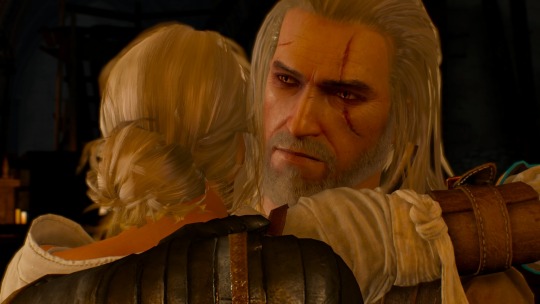
The Witcher 3 is a massive sweeping fantasy tale, that spanned over 150 hours for me to complete. I recently finished the game, and was very surprised by one fact. There was one thing that had more of an impact on me than anything else in the game, one thing that tied up Geralts journey as a character. We'll get to the specific line in a bit, but first we need to cover the relationship that Geralt and Ciri hold. I will warn you that significant spoilers on the end of the Witcher 3 lie ahead, so read on at your own peril.

Through much of the story of Witcher 3 Geralt spends his time on the trail of Ciri, a young woman that is basically a daughter to him. As such, you spend most of the game one step behind trying to piece together the path that Ciri took while also playing the elusive young woman herself at a few different points. This is the driving force behind Geralt in the game, although there's much more going on within the world Geralt's only worry is the safety and well being of Ciri.


With this fact in mind, it actually altered some of the choices I made through the story. For example, there's one plot-line in the city of Novigrad that has you hunting down a crime lord named Whoreson Junior. During the process of all this you find out what a terrible person Whoreson is, a person who enjoys sexually torturing women to death. You also find out that during the time Ciri interacted with him, he may have done something to harm her. While none of this is confirmed, the fatherly love that Geralt holds for Ciri prompted me to immediately end the life of Whoreson Junior.

It was a knee jerk reaction that I had in an instant because of the thought of what the man might have done to another character. This man needed to be gone from the world of The Witcher 3. It's not exactly commonplace that a game has this strong of an emotional response from me, and I was amazed with The Witcher 3 when it happened multiple times. As much as I'd love to go on and on about all the emotionally impactful parts, the point I have here is to highlight the incredible job Witcher 3 does with the father daughter bond of Geralt and Ciri.

Once you finally find Ciri and bring her back from The Isle of Mists, you begin the final stretch of the game. After the huge event of the Battle of Kaer Morhen, Geralt gets some quality time with Ciri as they mourn over the loss of a friend. Over the next few quests and plot lines, Geralt has five different choices regarding Ciri thrust upon him. The girl is having an incredibly hard time coping with everything and there are multiple occasions where Geralt gets to decide how to deal with Ciri. This can result in a warm fatherly approach, versus a cold disapproving father approach. For example, let me show you the snowball fight scene. This is moment where Ciri is frustrated and unsure of what to do next and how to do it. With the positive choice you get an incredibly heartwarming scene where Geralt tries to cheer Ciri up in the only way he knows how. Just watch.

Another scene involves Ciri upset with being deceived by the elf Avalla'ch, once again you can see the unique relationship held between the two and even more so the father, mother, daughter relationship the two hold with Yennefer of Vengerberg. Again it's easier to just show you; 


These two choices, and the three others involving Ciri decide the strength of her resolve at the end, as well as the chances for her to survive which leads to one of three major endings for you. I hope this can highlight the intense loving relationship that the two have. After all, Geralt spends 50-60 hours of the game merely on the hunt for Ciri, putting up with countless headaches and problems in order to find her. The way Geralt feels about her, shines through in both the dialogue choices as well as his facial expressions. The interesting thing is, that this holds true whether you pick the warmer or colder option on how to deal with her.

The two ways of dealing with Ciri create very different experiences for the player and a very different interpretation of the relationship between the two. The colder way gives you an impression of a Geralt that cares for Ciri deeply, but has no idea how to treat her like a father and feels uncomfortable with that fact. Feeling detached from the child he used to know, he feels disappointed with some of the brashness that Ciri approaches situations with and wants to ensure that she gains the skills and knowledge she'll need to survive. On the flip side, the warmer approach denotes a Geralt that sees a Ciri who has taken completely after him, and knows how to be the father figure that she needs as her real father was never there. Both approaches are valid, and both develop an incredibly deep but different relationship between Geralt and Ciri. 

Now that we've covered that, we can fast forward to the ending of the game. After the final conflict with the Wild Hunt, events find you at a tower where the cold winds of another world are blowing in threatening to drown the world in a giant freezing storm. At this point Ciri explains that because of the power of her elder blood she's the only one that can save the world from this fate. This realization is a huge shock to Geralt and something that has a huge impact on him, as you see his emotions get thrown into a state of chaos. It's in this moment that you have a dialogue choice as Ciri is preparing to enter the portal to the other world. This choice is where Geralt desperately says, " Don't do this... to me. Please. Not now." It's at this moment that we realize, Geralt isn't the main character of this story. He's a supporting one. Here's the ending in full, note that this is the ultimate 'good' ending. With the happiest story tones wrapping up here. Each ending of The Witcher 3 I feel does some good things in their own way, but I may go into that another time. 


Ultimately the choice in the end is Ciri's, and it's up to you as Geralt to support Ciri on her path how you can. But in this moment, you see a usually emotionally toned back Geralt break. His daughter is leaving, possibly going to her death and everything he's done will be for naught. After all, it's not the fate of the warring countries or the lives of non-humans that Geralt is truly invested in during this journey, it's the life of his daughter who is the single most important thing in his life. The time he spent with her was a reminder of the love that he held for her. 

This single line of dialogue ties up the relationship between Geralt and Ciri no matter what approach you took to dealing with her. Like I said earlier, it's an important moment of clarity for the player in which we realize that we've merely been someone on a quest, on the trail of the real main character of this plot. Which can explain a lot about the pacing of The Witcher 3. Of course, I don't want anyone to think this is a bad thing. It's an incredible moment, one where we realize the powerlessness that we have as players at the end. Yes we found Ciri. Yes we altered the course of the war. Yes we defeated The Wild Hunt. But in the end, we are powerless to stop the most important person to our character from leaving to her possible death. You do have an impact on the outcome of course, but this is in how you build your relationship with Ciri, how you treat her as she struggles to figure out how she deals with the fate she's been dealt. In that moment, you see Geralt become emotionally broken and powerless, with even Ciri stating " What would you know about saving the world? You're just a Witcher." 

Herein lies the beauty of some of the final moments of The Witcher 3, and what I believe to be one of the finest parent-child relationships in any game I've played. It builds up the level of care and love Geralt has through Ciri throughout the game, illustrating the lengths he goes to in order to ensure her safety. Then it yanks the rug out from under you, and reminds you that Ciri is her own woman and you don't get to decide what she does no matter how much you might want to. In a game that so intimately features player choice, it's a stark reminder that as players and as people we don't always have control over what others do, even when those people are important to us and our characters.  


Thursday, July 16, 2015

A Goodbye to Satoru Iwata

As you may understand at this point, video games have been a huge part of my life ever since I was a child. For myself and many others, we grew up with games. We played them through our child-hood and as we grew into adults.  This especially holds true with Nintendo, which is nearly a Disney equivalent of video games for many young people these days.


Just this past Sunday July 12th 2015, the gaming industry received sad news as one of the most incredible visionaries of it's ecosystem passed away. Satoru Iwata, the President and CEO of Nintendo has passed at the age of 55 due to a battle with cancer. It was very sudden and unexpected, and as we can see days later by the outpouring of tributes and kind words, Iwata was a man that made an overwhelmingly positive influence on the art form we love.

Iwatas influence on gaming and Nintendo was massive, he started as a programmer for the company HAL Laboratories in the late 80's where he would eventually be named president of the company in 1993, working on games like the Kirby, Earthbound, and Balloon Fight series. Following his career he would then be named director of Nintendo in 2000, and then finally as president and representative director in 2002, the first president of the company outside of the founding Yamauchi family. Besides his impressive resume, Iwatas lasting legacy on gaming can be seen in the wonderful experiences he helped to create and the unbridled joy he brought to the business at every opportunity.

 Satoru Iwata held a belief that video games were something fun at heart, and that everyone should be able to experience the joy that games can bring to our lives A noble sentiment to be sure, even if some may dispute the fact. Iwata always brought a smile and the feeling of joy to his work, and to fans. Throughout the years he led Nintendo through some drastic changes, Nintendo a company that had been stuck in their ways for years. Believing that what they did was best.

Since 2002, we've seen huge change out of the company under Iwatas leadership. Nintendo released the DS, changing the handheld game forever and introducing a new world of touch controls that changed how we play. A few years later they would introduce the Wii and revolutionize the face of video games, making them appeal to a broader audience than ever seen before.Even recently in the last year we've seen huge surprises from Nintendo, with Amiibo and the partnership with DeNA to make mobile games. The point is, Iwata wasn't afraid to be different to make the experiences we get from Nintendo as best as they can possibly be.

There's a quote from the late president that has been all over the internet this week, "On my business card, I am a corporate president. In my mind, I am a game developer. But in my heart, I am a gamer." Iwata understood what video games were more intimately than most people, which is why he had such dedication to what Nintendo did. We saw the advent of Nintendo Directs that usually featured Iwata heavily, he wanted fans to know he was there and that he cared. How many CEOs of billion dollar companies can we name by name, let alone feel like we knew personally? Satoru Iwata was welcoming, warm. He wanted to share Nintedo's creations with us, he was excited to share their wonderful imaginative creations with his fellow gamers. 

Nintendo games were hugely influential for me, and held some of my absolute favorite experiences of my childhood. From roaming the expanse of Hyrule field in Ocarina of Time, to blasting through asteroids and enemy ships with my Arwing in Starfox 64. These experiences helped form my identity as a gamer and a consumer of entertainment. The games that I play helped breed my imagination. During recess in elementary school my friends and I would pretend we were flying around in Arwings, shooting down bad guys while we made whooshing noises to imitate the ships.

To myself, Nintendo is so special because it captures the very essence and wonder of that childhood imagination. It reminds us all what it is to be pure fun and imagination. Just look at how fondly people remember their experiences with Mario, Zelda, Kirby, and the other titles in the incredible stable Nintendo has. These games and experiences that I had as a child, are what led me down the path I'm on today. I would be enraptured by Majora's Mask as a child, and years later come back to analyze it on the themes of sadness and grief that the game was inundated with. Game like Zelda, Star Fox, and Mario helped to breed a strong passion for gaming withing me and are definitely one of the biggest factors in my decision to work in this industry.

Games are at their best when their inventive and fun, they can be wildly immersive experiences. My ultimate goal is to make games myself after I have a wealth of experience in the industry, and with what I make I want my games to be strange and thoughtful experiences. I want them to make people feel things, and think things. Nintendo holds so many joyous experiences for so many of us, and Satoru Iwata helped get those experiences to us and make them as great as they could possibly be. He was a visionary, that taught us things about not only how we should make and experience games but what video games can mean to us and how we feel.

The industry mourns for him, and the outpouring of support and love for him as been heartwarming. He will be sorely missed, so many of us owe so much to him. As creators, as consumers, as gamers we will never forget the contributions he made. And as a small side note, the day after Iwata's untimely passing a rainbow was spotted over Nintendo's headquarters in Kyoto, Japan. A fitting tribute as we all hope Iwata made his way down the never-ending rainbow road.


Tuesday, June 23, 2015

Inside Out is the Best Pixar Movie Ever Made


Trying to decide the best Pixar movie is like trying to decide the best dessert at a critically acclaimed five star dessert bar.  We all have favorites, but certain ones resonate with us more than others and it may be different from person to person. Once thing can be sure thought, Pixar makes great movies that oftentimes illuminate things about life and the human condition.

When I saw Ratatouille I was convinced that no other Pixar experience would surpass it for me. The story of Remy and his plight to be a chef was an incredible underdog story, that taught us to follow our dreams and put all our effort in no matter the odds against you. To my incredible and joyous surprise though, I recently saw a movie that rivaled the Ratatouille experience for me and maybe even surpassed it. That movie was Inside Out.

I had been looking forward to seeing Inside Out for a while, but I didn't expect the emotional heartfelt journey that awaited me. Pixar has always been infamous for building incredible movies that make us think, beyond being enjoyable. Every movie they make has a theme or a message behind it, but never before has an animated movie been so much about looking inside ourselves as Inside Out. Even just the name denotes that very thing.

Inside out focuses on a young girl named Riley. A girl who, love hockey, does well in school, has a great family life, and has a happy young childhood all around. Underneath things though, the characters we get to know are Riley's own human emotions. That of; joy, sadness, anger, fear, and disgust. These emotions are characterized as their own beings, entirely focused on that single emotion and instilling that emotion in Riley through a console in Headquarters (or Riley's mind.)

We see Riley grow up and have a wealth of happy memories being developed by the emotions, but when she turns 12 the whole world gets turned upside down when the family moves to a tiny house in San Fransisco. This sees the emotions of the young girl run wild as her life gets much more complicated. Through the lens of humanized emotions given character, we see the mind of a twelve-year-old girl go through  emotions trying to make sense of the change in her life. Inside Out shows us how conflicted and emotionally unstable a developing teenager can be when massive change happens.

Through this brilliant storytelling mechanism, the master storytellers at Pixar walk us through the story of a young girl coping. Inside Out as most Pixar movies is a ton of fun, but on top of that it has a wonderful message to impart to it's audiences. We see the characters travel through multiple parts of the human psyche, including imagination and the subconscious, as well as memory banks. Of course Pixar finds fun ways to play on each of these things, making it funny and heartfelt throughout. My personal favorite scene of the movie includes two characters hilariously trying to scare Riley awake through her dreams.

At various points we see the emotions of other human characters throughout the movie reacting to things that Riley does or things in the world. No doubt, some of the impact and message is lost on me with Inside Out as I believe anyone who is a parent will especially find meaning in the movie.


---------Slight Spoiler Ahead----------


Partway through the movie we see Riley lose the ability of her joy and sadness emotions. Because of this she reacts to things in very different ways. Lacking those emotions it's basically like those have been turned off. Through trauma in our lives, especially when we're younger it may be difficult for us to feel certain emotions. For anyone who's life has undergone a sudden change like myself, I believe we can identify with this. While the movie finds a fun storytelling way to do this, it's something that resonated very much with me. Sudden change like that at such a young age is incredibly scary and numbing, and although I never moved away from what I was used to I did find ways to identify with the movies story.

Growing up I lived a fairly sheltered life, as my parents went through a horrible divorce and custody battle through much of my adolescence I found myself very much without friends throughout middle school and high school. I spent my time with entertainment, as my mother was unwilling to let me go anywhere without being watched, or just spend time with friends by myself. This feeling of loneliness permeates your life, causing you to feel those emotions like fear, and anger and sadness more than anything else. Then at a certain point you lose the sadness too, and once joy and sadness leave you have only the emotions left that can cause you to do drastic things. Being driven by fear and anger causes you to think irrationally, and when you're a developing mind you may not know how to handle those emotions correctly something Inside Out shows perfectly.

The real beauty of Inside Out lies in just that, it shows something that many of us have gone through in our lives. The confusion of growing up and not knowing how to cope, or the confusion of dealing with a child going through that and not knowing how to help them. Pixar has impressed me on many many occasions in my life so far, but never have they created something so emotionally impactful and resonant for me. This is what our entertainment should be, incredibly insightful and meaningful pieces that cause us to think or feel something. Or something we can share with others, that will bring us closer. Which is also what I think Inside Out is, a piece that everyone can connect to and a movie that parents and children and families all need to see.

Indeed, Inside Out shows us the importance of taking time to be with not only the people we love but the things we love to do. In Riley's mind the things that are important to her form into islands. There's hockey island, friendship island, and family island among other things. These are the focal points of her life and what forms the basis for her as a person. We have to embrace the things we love.

Without droning on too much, I'd rather have you see the movie yourself. Let me just say that Inside Out is a masterpiece of animation and storytelling, everything about it is impeccable right down to the execution. It's an incredible piece of cinema that teaches us about the very most inner working of ourselves as humans. It's a piece that everyone young or old can connect to, and a movie you owe it to yourself to see. There's no doubt in my mind at this point that Inside Out is the best movie Pixar has ever made, and if you haven't seen it yet I hope that you choose to do so now. Inside Out is what we should strive to do with our entertainment, and I'm happy that I had the chance to enjoy it.